miércoles, 22 de diciembre de 2010

Unas escaleras por las que subir a un Año Nuevo muy especial para nuestro Instituto


Es una imagen tardía con la que celebrar el Año Nuevo. Parece una contradicción, pero no lo es. La última imagen de este blog, que quiere ser una despedida hasta otro año que ya viene y que ojalá sepamos cargar de novedades, sólo tiene cincuenta años. Los cincuenta que cumple el noble edificio en el que pasamos buena parte de nuestras horas. Es época de aniversario, del cumpleaños de un Instituto ya cincuentón que mira orgulloso su pasado, su patrimonio histórico, pero que también desde esta plataforma del siglo XXI quiere proyectarse hacia un futuro en el que sepamos remontar todas las dificultades que nos acompañan. La historia no es al final sino un espejo retrovisor con el que mejor poder conducir nuestras vidas, siempre hacia adelante.

¿Localizáis este espacio en nuestro Instituto? Son las mismas escaleras de siempre por las que ya varias generaciones han subido para formarse y construir la Málaga que conocemos. Una escalera es un buen símbolo de despedida. También de ilusión ante uno año nuevo en el que todos podemos ser mejores, subiendo peldaños en la mejora de nuestro centro.

jueves, 16 de diciembre de 2010


Now that holidays are very close I invite you to read last year article in this blog on the topic Christmas.

Christmas is a time of joy and of overeating too. We eat lots of sweets and most of the time we forget about healthy habits.

A group of 2 º ESO students have asked their partners about their healthy habits . It may surprise you that half of the interviewed students , whatever their age, eat junk food (comida basura) twice a week. Or that only 50% of them practice any sport at all, talking about teenagers this number should be higher, don't you think so?


AGE
12

13

14

15

16

Do
you brush your teeth every morning?
70 %

90 %100 %100 %100 %
Do you eat two
pieces of fruit everyday?
40 %

40 %60 %80 %80 %
Do you practice
any sport?
60 %

50 %50 %50 %50 %
Do you eat pizza
or hamburgers twice a week?
60 %80 %30 %50 %50 %

Affirmative answers

At least most of them brush their teeth and eat fruit everyday!

How about you? Do you think that hamburgers or pizza could be healthy too?

viernes, 12 de noviembre de 2010

Robots are not science fiction any more

And now, let me introduce you to your new teacher, nurse, shop assistant, friend...

Watch this and think of your future: Female Android Geminoid F

jueves, 11 de noviembre de 2010

On 2nd November a group of 2 ESO students went to Málaga airport. They want to tell us what they saw:

“We visited the old airport. It was the first one in Málaga. There is now a museum. We got into three old planes.”

Carolina Riffi, Sara Ponce and L. Tarrazona

“There were dummies of air hostess and pilots. We watched them through a window”

Lidia Soler and MiriamVacas

“We went to the map room, there was a map of the airport. We also saw a helicopter, it was very large and it was just painted”

Antonio Sánchez and Moisés Córdoba

“We were at the old airport. Tere were many different rooms. There was a video room. There were som prototipes of the old plane, another room was about the history of the planes. There was a garden and you could see the private planes from there.”

Guillermo Gutiérrez and Álvaro Camacho

“We went to the airport and we saw the museum teaching material. There we learned playing, we dressed up, we moved parts of planes, etc.”

Araceli Rodríguez and Carmen López

“Finally, we saw Roman tumbs. The workers discovered them when they were doing the museum. We saw a well too.”

Lorena Martos, Samara Santiago and Israel Jiménez

martes, 2 de noviembre de 2010

Descubrir Málaga: La Torre de Martiricos


Efectivamente, se trata de una torre y está en Martiricos. Quienes atraviesan la Avenida del Doctor Gálvez Ginachero para ir o venir del Instituto se tropiezan –aunque me consta que muchos no la ven- con esta torre que no es lo que parece. El viandante piensa que formaba parte de alguna edificación religiosa y hay quien se atreve a decir que lo era de una ermita dedicada a los patronos de Málaga, San Ciriaco y Santa Paula, que fueron martirizados en esta zona de la ciudad.

Nada más lejos de la realidad. En realidad se trata de una alcubilla, una especie de depósito que recogía y distribuía el agua hacia otras zonas de la población. Por tanto forma parte de una red de abastecimiento de agua muy antigua que tenía Málaga en la Edad Moderna. Si os fijáis bien, en la cara que da a la Avenida hay una lápida que data de 1690, cuando reinaba en España Carlos II, en la que se da cuenta de unas reformas habidas en esta alcubilla. ¿Os atrevéis a leerla?

Desgraciadamente, la torre no está muy bien cuidada. Sin embargo no deja de ser un edificio interesante. Arquitectónicamente podríamos describirla como una torre exenta de planta cuadrada, organizada en dos pisos. En el superior se abren unos vanos arqueados de medio punto. La torre se remata con un curioso tejadillo a cuatro vertientes con azulejos blancos y verdes, dispuestos en zig-zag. La corona una veleta y una cruz de hierro. La torre se levanta en sus cuatro fachadas con unas pilastras lisas que también sirven de elemento decorativo. En una de las fachadas se añadió, ya en el siglo XX, una fuente que permite una mejor integración con los jardines que la circundan.

Espero que, a partir de ahora, la miréis con otros ojos... O que, simplemente, la miréis.

domingo, 24 de octubre de 2010

A espaldas del Picasso hay otro Museo por descubrir

Deprisa, deprisa, los turistas atraviesan la calle Cister para ir del Museo Picasso a la Alcazaba sin dejar atrás la Catedral. Algunos de ellos –y muy pocos malagueños- reparan en una pequeña bocacalle que cierra una iglesia presidida por la imagen de Santa Ana y la Virgen Niña. Pero con sus prisas no dan el paso para entrar en un pequeño Museo –el Museo de Arte Sacro de la Abadía Cisterciense de Santa Ana- y se pierden una colección de obras de arte de gran interés y de particular encanto. Unas obras que, además, han sido expuestas con especial sensibilidad y que pueden verse prácticamente en soledad. Se trata de una Iglesia y un Museo, además, donde habita de algún modo el espíritu del gran imaginero Pedro de Mena (1628-1688). No en vano su taller estaba en la cercana calle Afligidos, en el convento profesaron sus hijas como monjas de la Orden del Cister y él mismo está enterrado en la Iglesia.

El Museo se estructura en torno a cuatro salas y en cada una de ellas hay algunas obras de especial relevancia. En la primera, dedicada a la historia del Cister, os recomiendo os fijéis en la singularidad de la Virgen Abadesa entronizada y en la Inmaculada del propio Pedro de Mena que sigue aquí el modelo de Alonso Cano.

En la segunda hay que detenerse en la imagen más antigua que se conserva en la provincia, la Virgen de los Peligros y Buen Suceso –siglo XIII. Los amigos de la Semana Santa quedarán encantados con la túnica del siglo XVIII del Cristo del Despedimiento y, sobre todo, con el terno original del Señor de la Pollinica, que tienen a su lado los arreos del animal. Impresionan también los bustos del Ecce-Homo y la Dolorosa que Pedro de Mena esculpió para su capilla funeraria. Pero os resultará particularmente insólita la colección de Cartas de Profesión, magníficamente pintadas con diversos motivos e imágenes, que entregaban las monjas al hacer sus votos. El nombre de la sala hace honor a todo lo que se expone: Imágenes del Barroco.

En la sala tercera –Intimidad y Clausura- os impresionará la talla de San Miguel Arcángel de Fernando de Ortiz, afamado escultor del siglo XVIII, y la exposición de miniaturas, especialmente los llamados escaparates, que constituyen toda una colección de arte doméstico.

Finalmente, la cuarta sala, denominada Sueño de vida y muerte, está dedicada a una inusual colección de Niños de Pasión, imágenes de un Niño Jesús que ya desde su infancia quiere adelantar el destino que le esperaba en la cruz y, por ello, como imágenes propias del barroco, se acompañan de los símbolos del martirio. Fijaros especialmente en el popular Niño Jesús de la Espina.

Y es que el arte, también en Málaga, nos espera a la vuelta de la esquina.


Halloween is an annual holiday celebrated on 31st October. The historian Nicholas Rogers, exploring the origins of Halloween, has discovered that its origin is Celtic. The ancient Celts thought that the line that joins this world with "another world" was bigger with the arrival of the Samhain (a similar party).

The harmful spirits are removed. It is believed that sweets and masks are used to banish the malignant spirits. In Scotland the spirits were supplanted by young men with white masks. The word Halloween means: All Hallows Day.

There are different ways of representing this party: the pumpkins, the candles... Halloween imagery includes themes of death, evil, the occult, magic, mythical monsters, ghosts, witches, skeletons, vampires, werewolves, demons, bats, and black cats. Black and orange represent the darkness of night and the color of bonfires, autumn leaves, and jack-o'-lanterns.

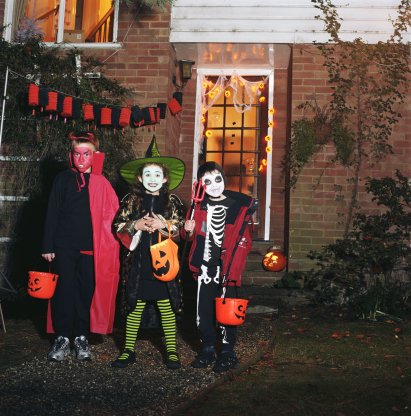
Children go to houses asking for sweets. The typical phrase is: trick or treat. Halloween costumes are traditionally modeled after monsters such as ghosts, skeletons, witches, and devils. Over time, the costume selection extended to include popular characters from fiction, celebrities, and generic archetypes such as ninjas and princesses. Dressing up was prevalent in Scotland and Ireland at Halloween by the 19th century. Costumes became popular for Halloween parties in the US in the 20th century, for adults as well as for children.


The first mass-produced Halloween costumes appeared in stores in the 1930s in the United States.There are also costumes of pop culture, like presidents, athletes, celebrities, or film, television, and cartoon characters. Another popular trend is for women (and in some cases, men) to use Halloween as an excuse to wear sexy or revealing costumes, showing off more skin than would be socially acceptable otherwise. There are several games traditionally associated with Halloween. One common game is dunking or apple bobbing, in which apples float in a tub or a large basin of water and the participants must use their teeth to remove an apple from the basin. Another common game involves hanging up treacle or syrup-coated scones by strings; these must be eaten without using hands while they remain attached to the string.

Halloween is not celebrated in all the countries and regions of the world. Celebrations in the United States and Canada have had a significant impact on how the holiday is observed in other nations. In my city, Málaga, I meet my friends and we celebrate a party with many sweets. We do many games too. Our favorite game is after turning off the lights, we hide and a person must find us. It's called The Black Hall.

Angel Luís Díez López, 3º ESO B

Halloween is a very famous party in UK, but in Málaga too. Here, children go to the houses to ask for sweets, and some people give them money.

Children dress up and make-up to be scarier than their friends. Children dress up as vampires , witches , Frankestein and as ghosts.

The English people that live in Málaga give a lot of money and many sweets to the children because they remember their cities.

The typical colours are orange, black and red. Some people buy pumpkins to decorate their homes.

Carmen María Méndez Moreno 3º ESO B


Halloween will be here soon!

This typical English and American celebration is very popular in the world. Halloween is a very ancient celebration in honour of the dead.

People feast it in UK, and America of course, but in other countries too, like, for example, in Spain, concretely in Málaga, the city where I live.

In Málaga, teenagers and kids go out with their friends at night. Usually, kids disguise like monsters, ghosts, witches, sick-people, dead-men and dead-women , Frankenstein, the dead bride… and then, they go to their neighbours' houses to request candies and lollipops with the typical sentence “trick or treat” (like the English and American kids do).

Teenagers don´t always do the same; some of them make parties at friends' houses , or they meet and tell stories of fear, or they impersonate kids… some of them don´t celebrate it.

Another thing that they do for Halloween is to scare friends with all kinds of jokes .

Finally: don´t stay at home in Halloween!

Candela Mesa Cuevas 3º ESO B